



A renovated 18th-century chateau with outhouses and over seven hectares of grounds, nestled
in France’s Yonne department in Burgundy, between the towns of Chablis and Auxerre
in France’s Yonne department in Burgundy, between the towns of Chablis and Auxerre
Auxerre,
YONNE
burgundy
89000
FR

Location
The property lies in the north-west of France’s Bourgogne-Franche-Comté region, in the heart of the country’s Yonne department. The backdrop is bucolic, yet there are medium-sized towns close at hand. There are many attractions nearby. The town of Auxerre is officially recognised for its built heritage. The area is widely covered with vineyards. The spectacular Morvan regional nature park with its wooded hills and the beautiful Forêts national park are around an hour away by road. There are also woods and forests closer to the property, less than 45 minutes away. Auxerre is 20 minutes away. The town of Chablis is 15 minutes away. And the A6 motorway, with a slip road just 15 minutes from the property, takes you to Paris in 2 hours and 20 minutes.
Description
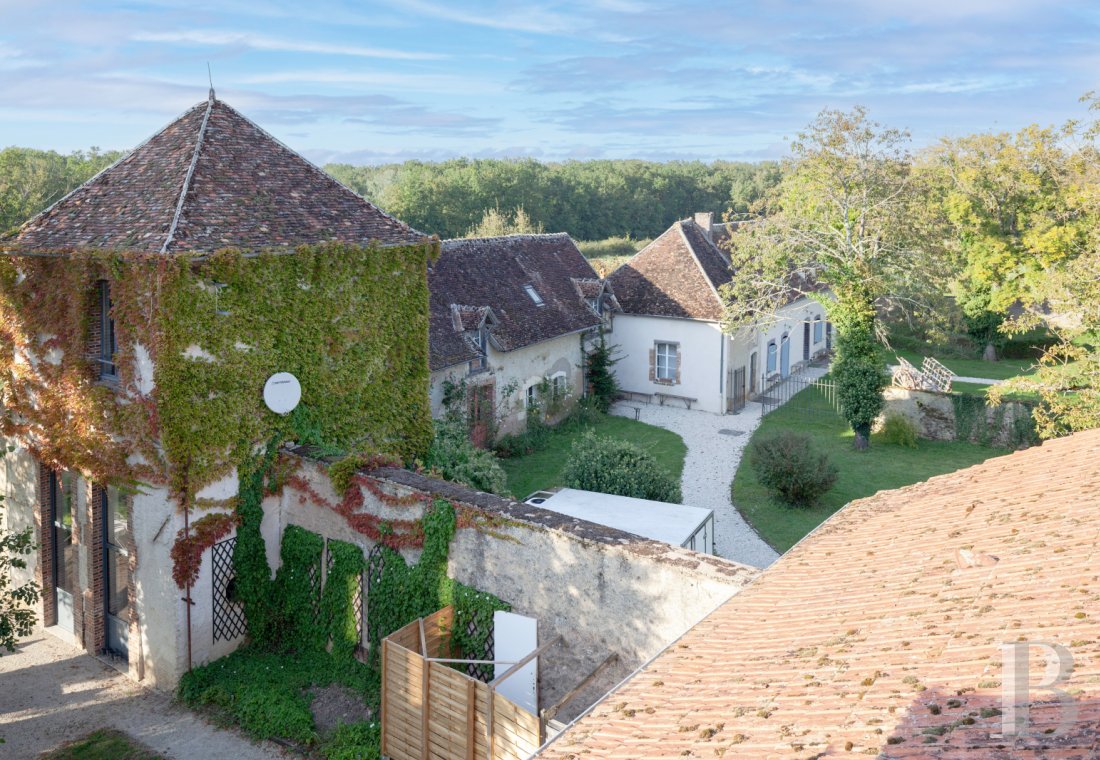
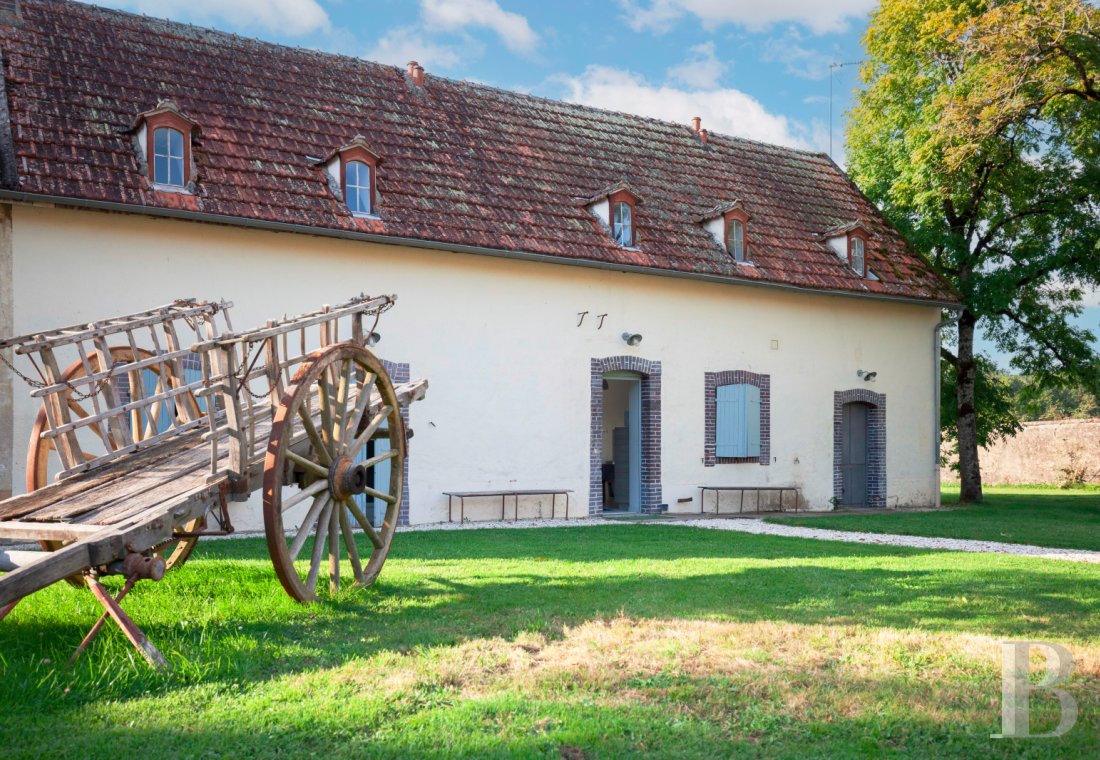
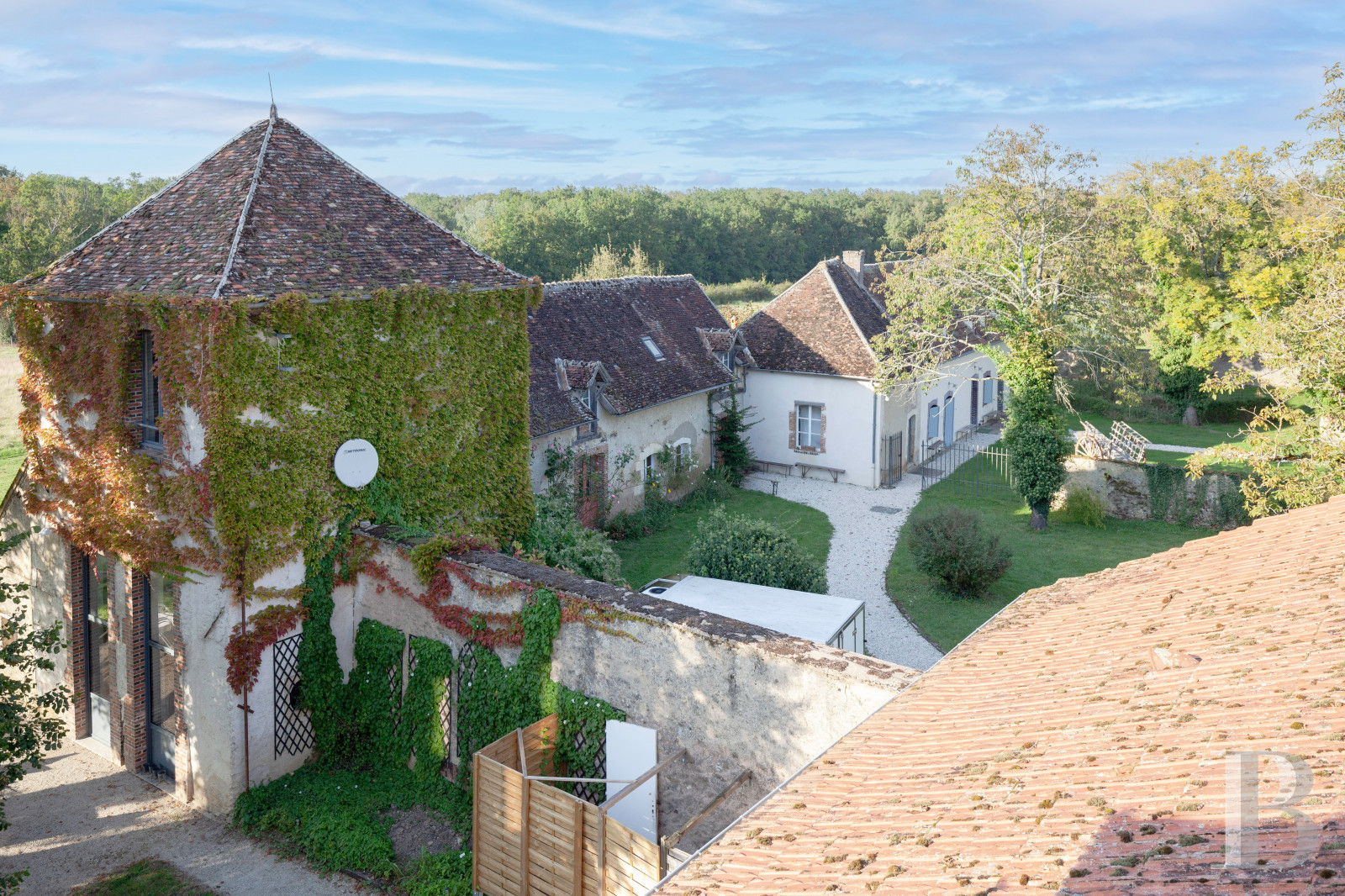
The estate covers more than seven hectares of unbroken land. It is made up of meadows and woods. Three gates lead into the estate. One of them takes you to a car park for guests staying here. Indeed, the place today offers accommodation and dining. The chateau is neo-Gothic in style. It stands at the south end of the plot. The outhouses, which are more rustic in style, lie towards the north. The latter stand opposite one another, separated by a walled court with a lawn, shrubs and trees. The chateau was built in the 18th century. The outhouses date back to the 19th century. The elevations are made of dressed stone with rendering. The outhouses have pointing that leaves the stonework slightly exposed. Most of the windows are rectangular or slightly arched. They are set in surrounds of brick or dressed stone. The roofs, punctuated with dormers, roof windows and chimney stacks, are almost all covered with local flat tiles. Three of the chateau’s slopes are covered with slate tiles. The roofs have different shapes. The chateau has a ground floor, a first floor and a second floor in the roof space. The three main outhouses, which can be lived in, were fully renovated in the 2010s and have a ground floor and a first floor.
The chateau
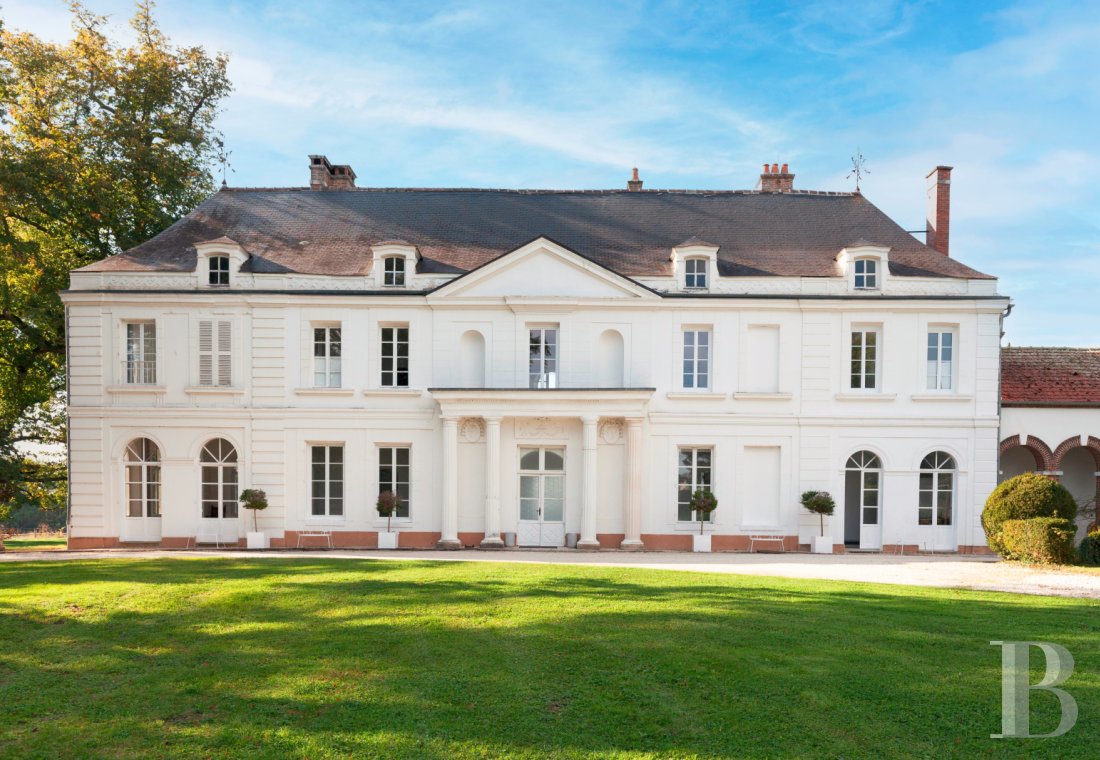
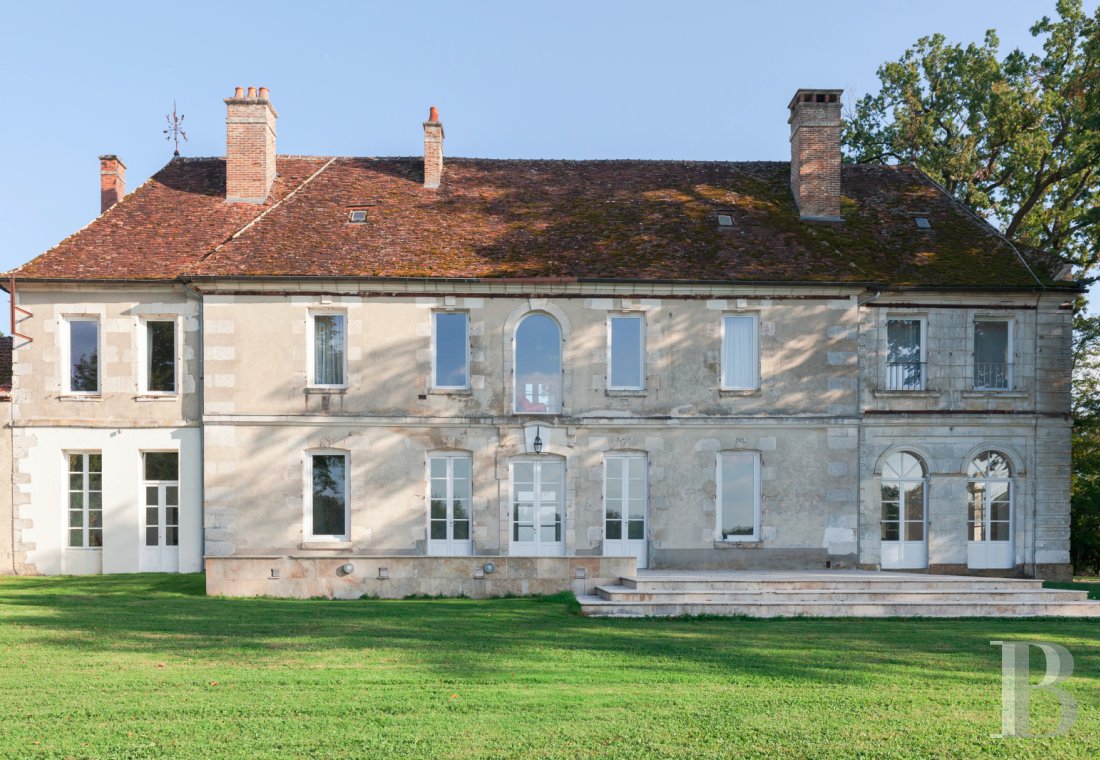
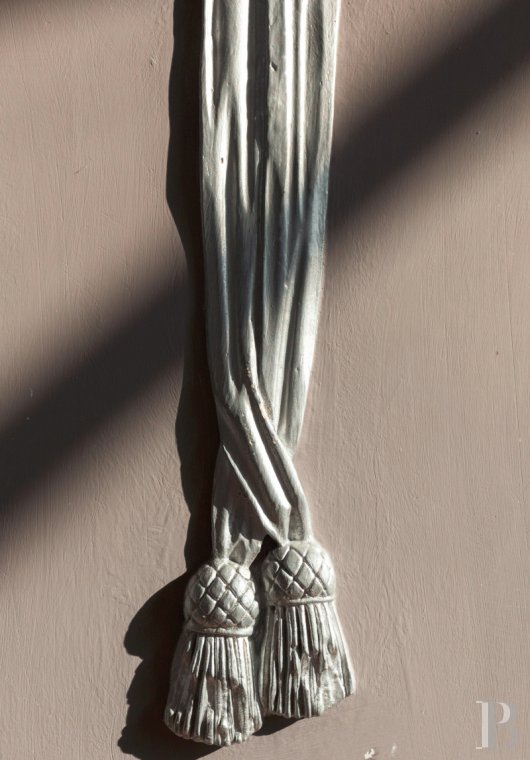
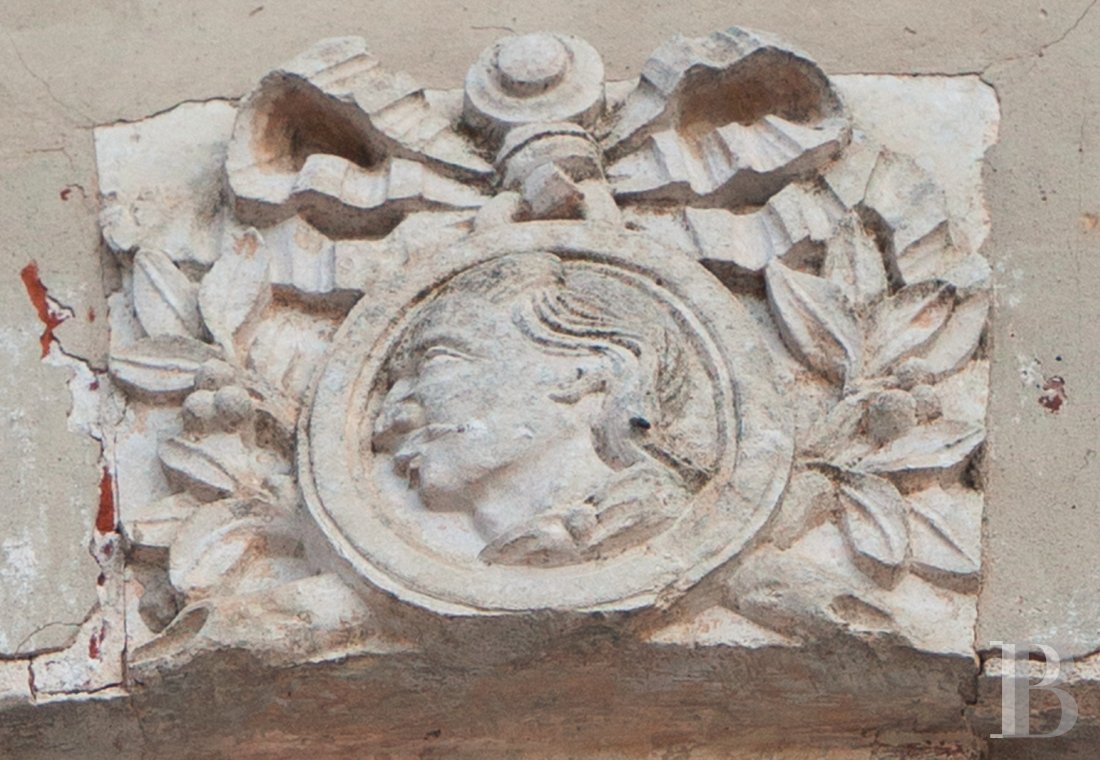
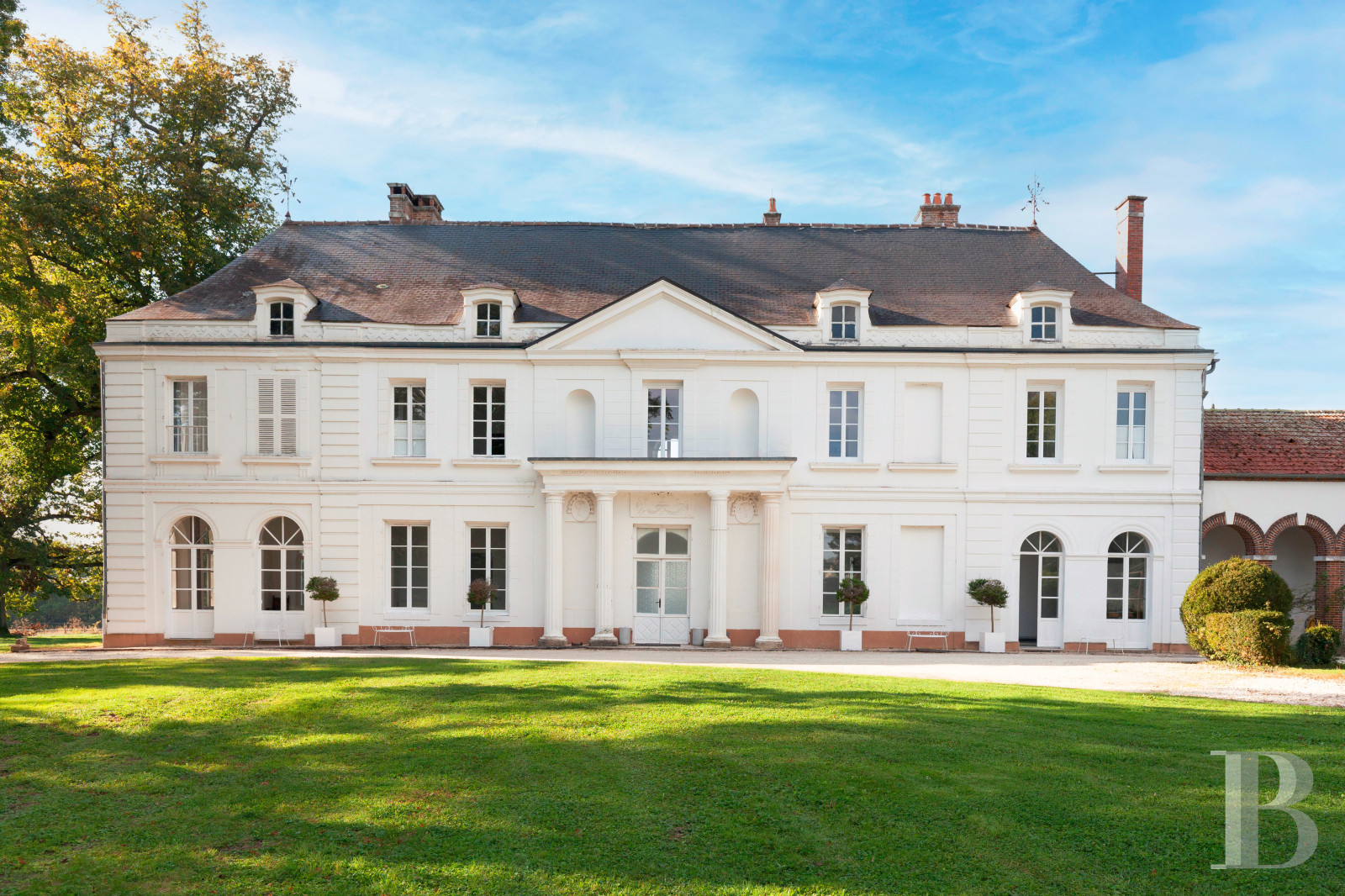
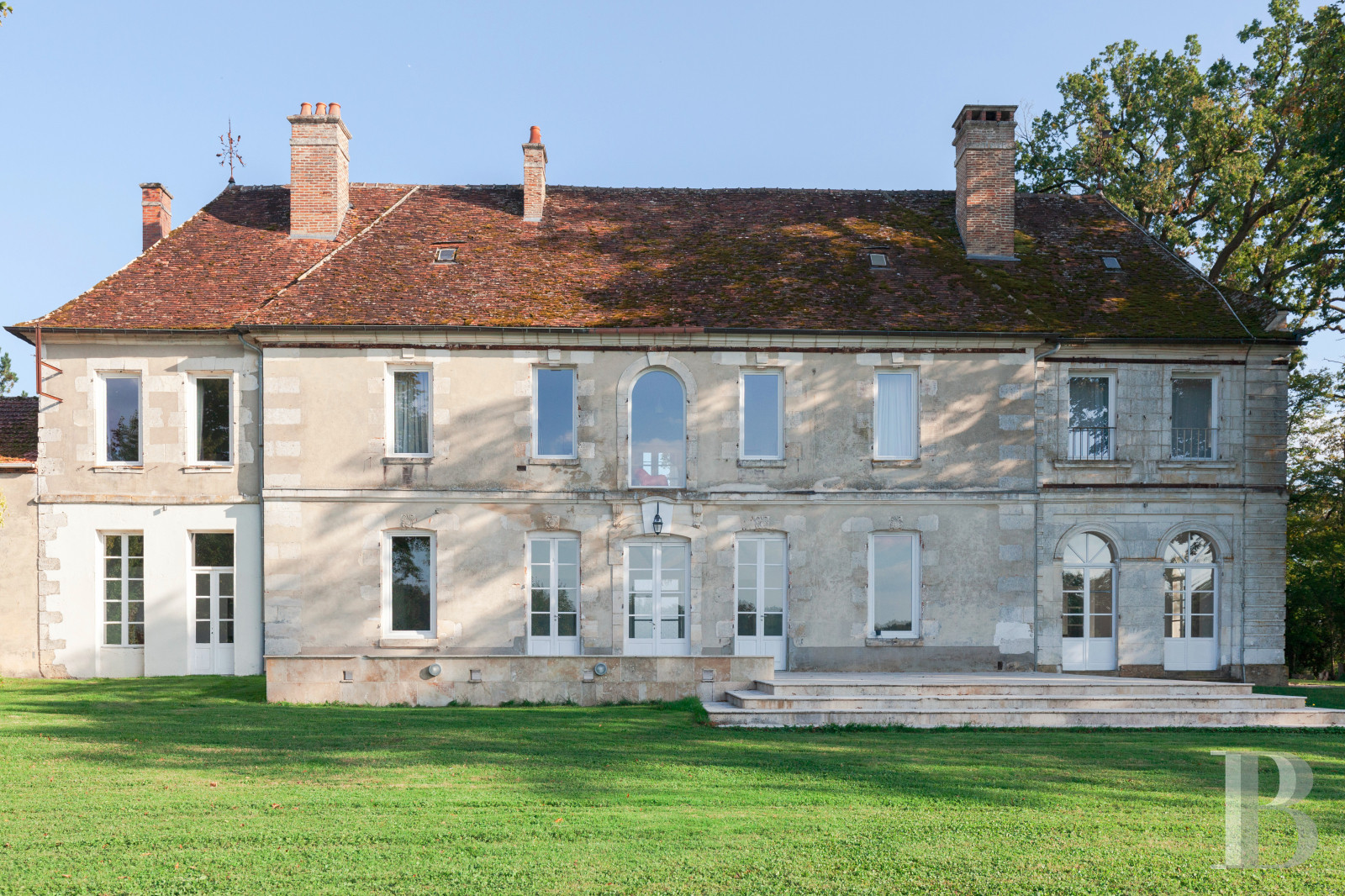
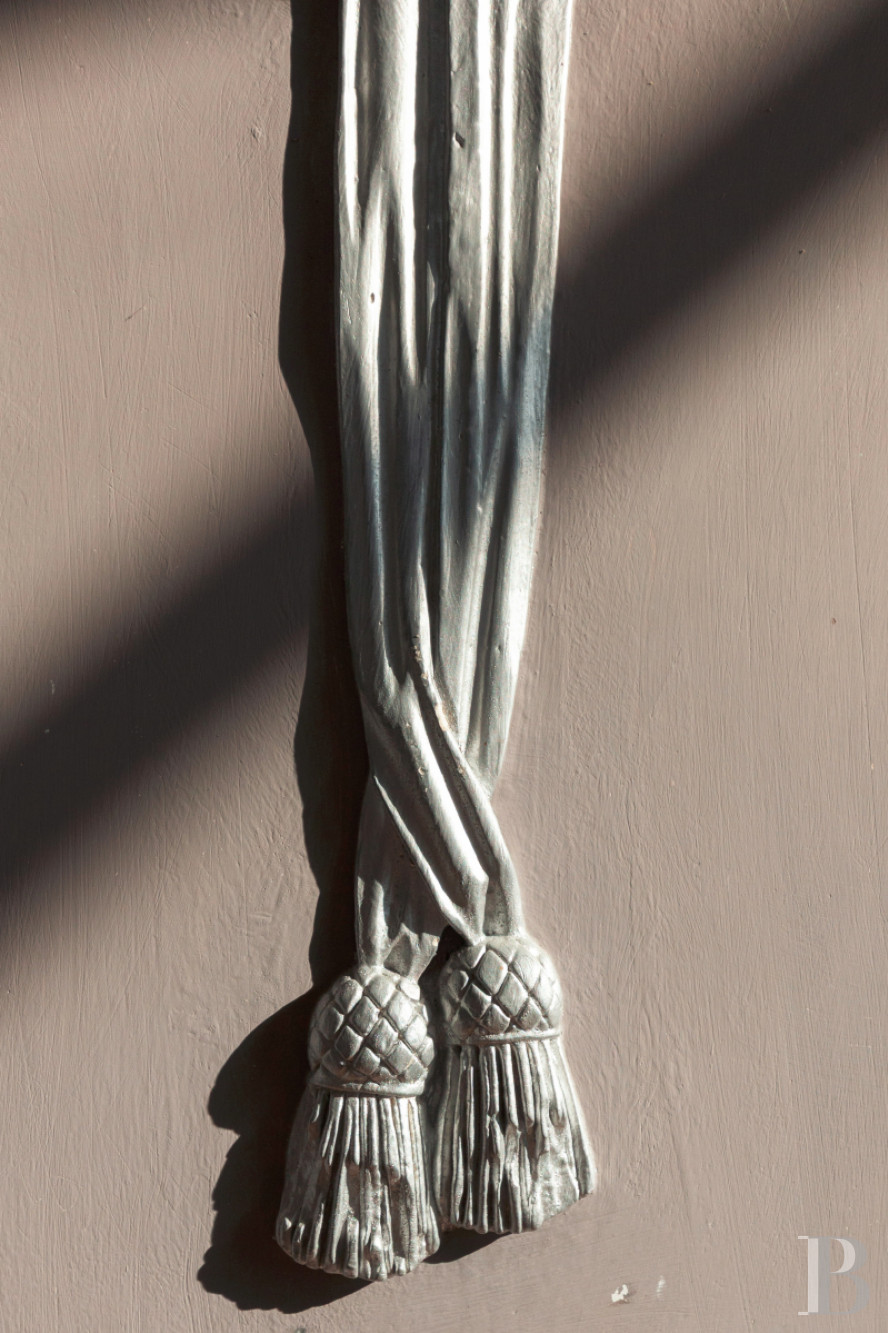
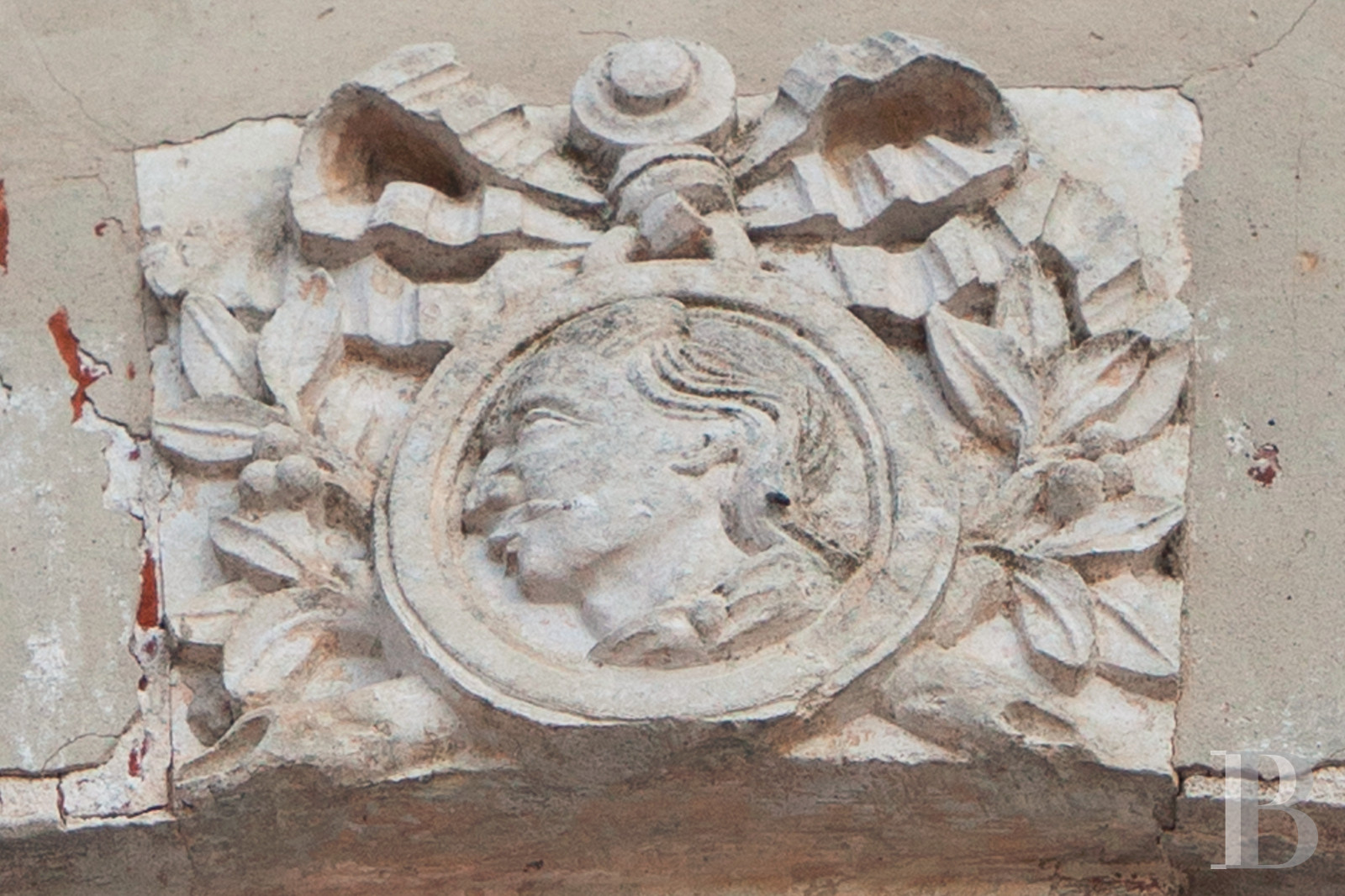
The chateau is neo-Gothic in style. The main section’s facade is punctuated with evenly spaced bays centred upon a faux avant-corps with Doric columns. This avant-corps is crowned with a triangular pediment, above a window framed between two alcoves. Medallions frame a frieze above the fanlight of the entrance door, which is made of painted wood with glazing. The window surrounds are rectangular, except for the four sets of French windows in arched doorways at the ends of the ground floor. The window surrounds are plain in design, with mouldings or blocks in relief – the latter ornamentation marks the two end sections and forms the quoins too. The windows and French windows are large-paned. The rear elevation faces west. It has kept features of an older period, including four lintels with medallions. The roof has four slopes, three of which have slate tiles and one of which has Burgundy tiles. The facade-side roof slope also features a series of dormers, the lower parts of which interrupt a frieze that runs around three sides of the edifice. Chimney stacks of brick and two compass roses crown the roof.
The ground floor
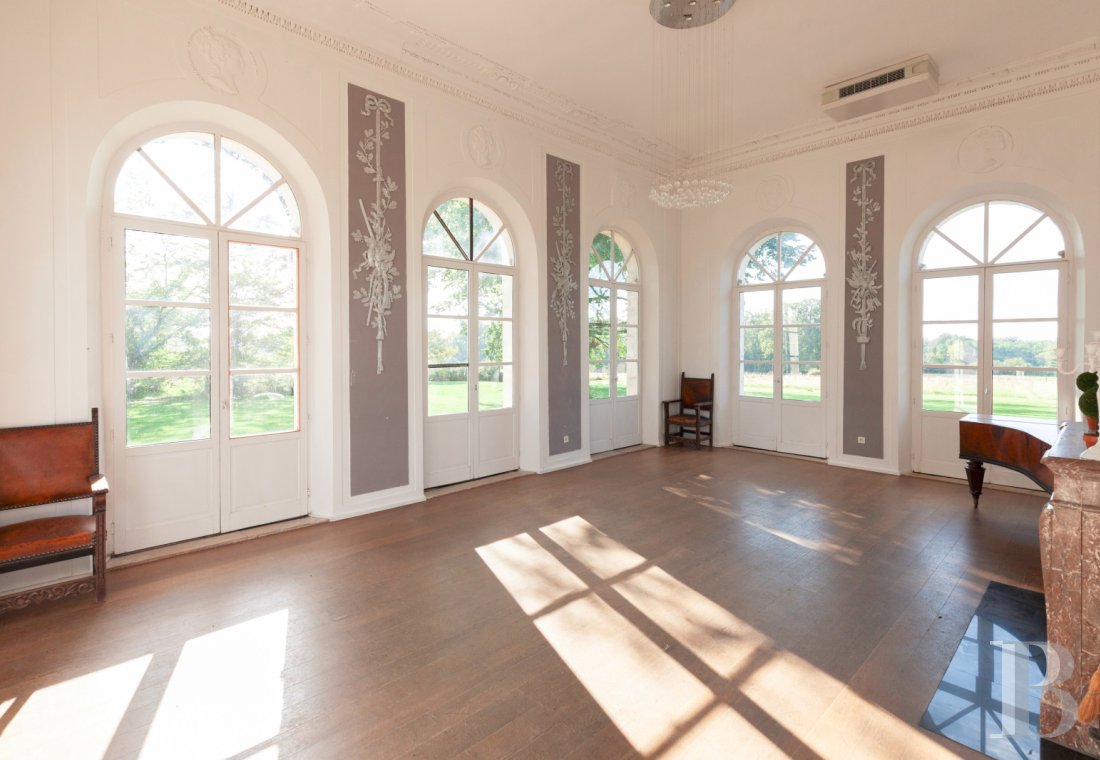
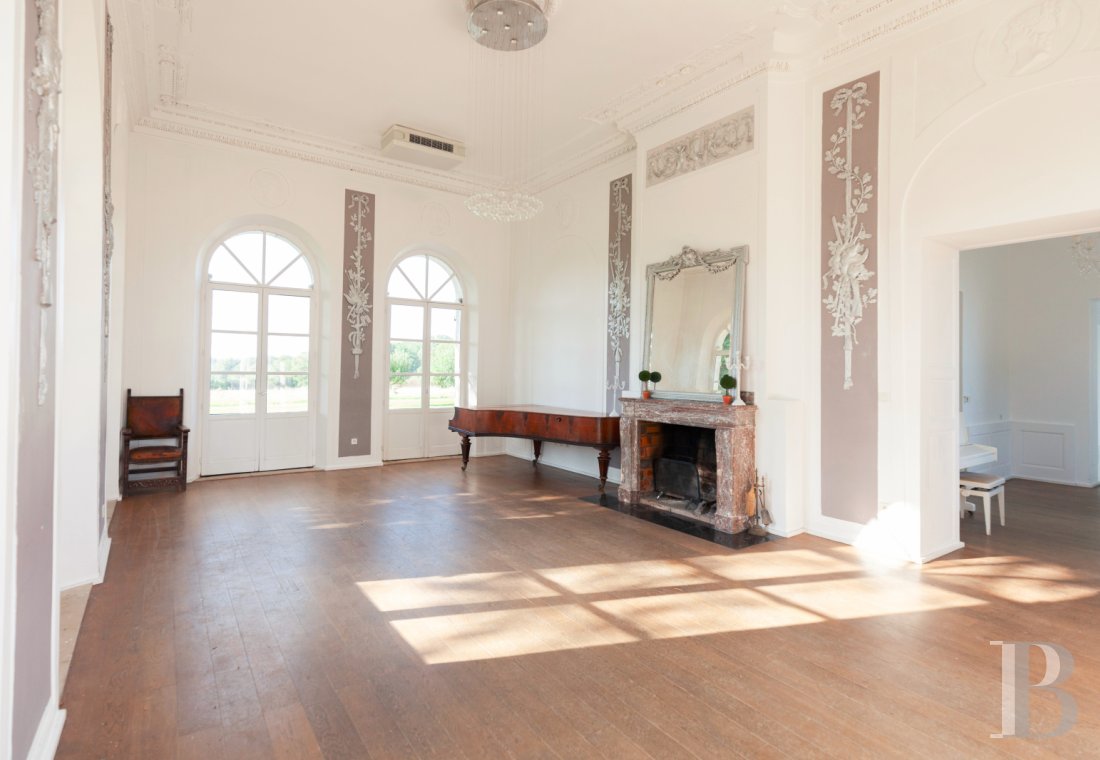
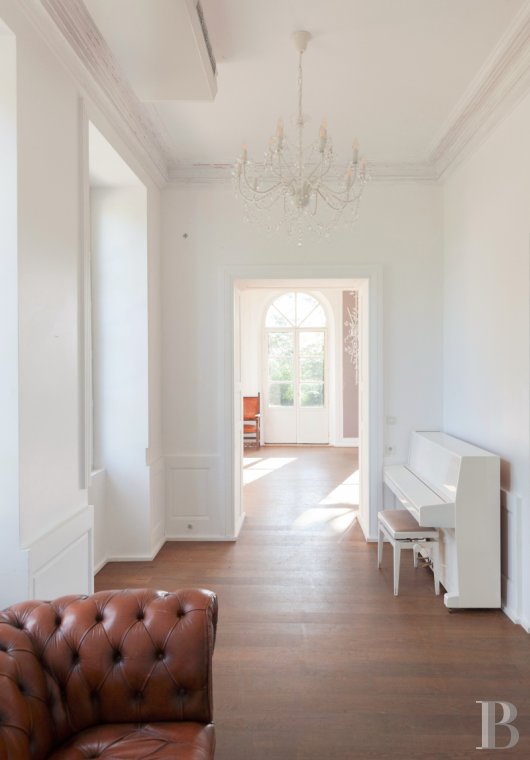
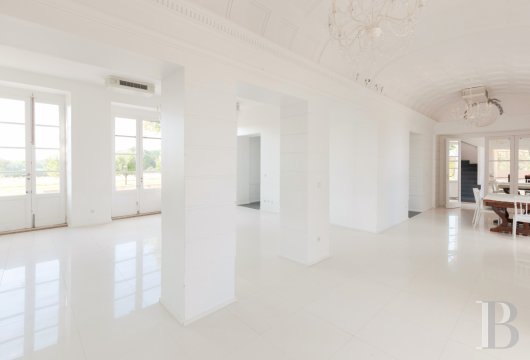
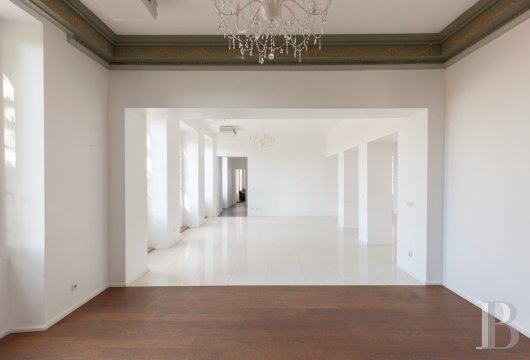
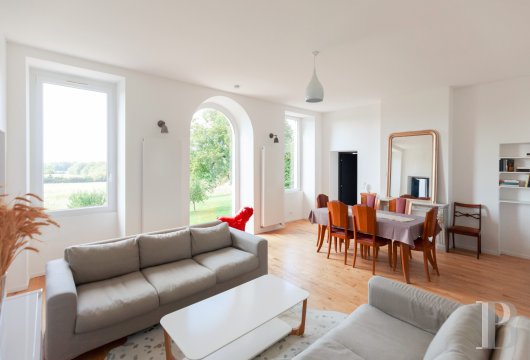
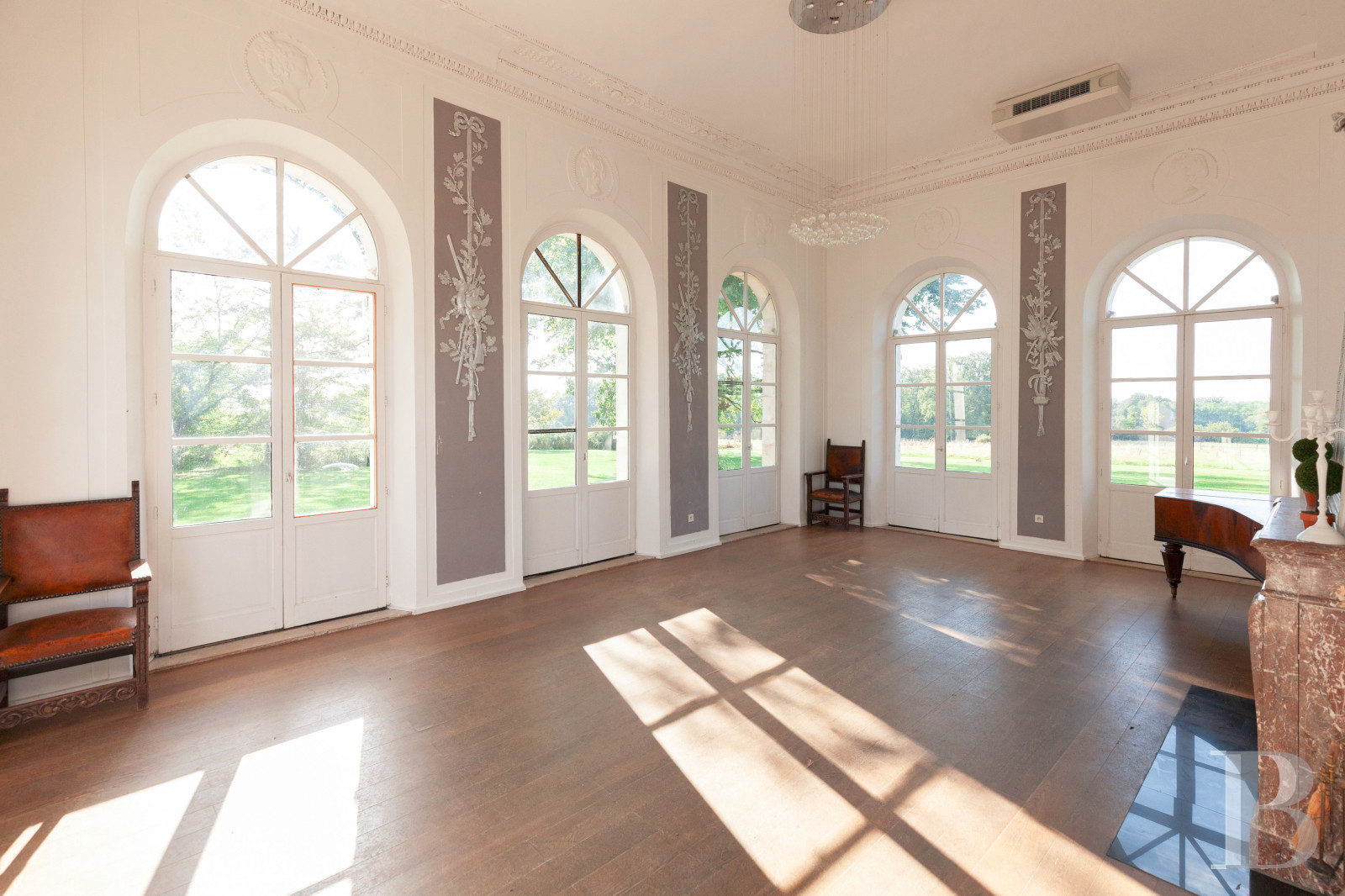
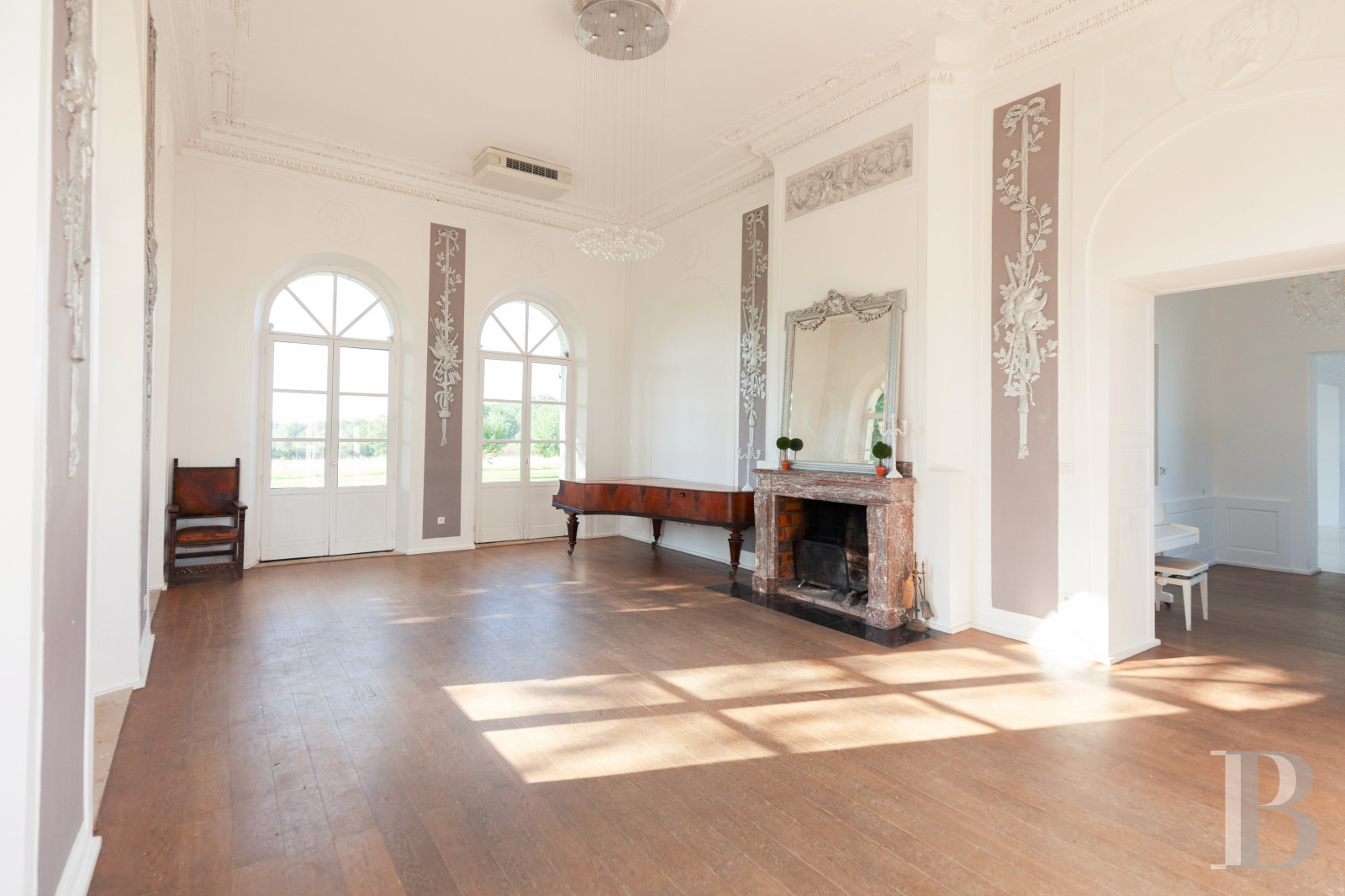
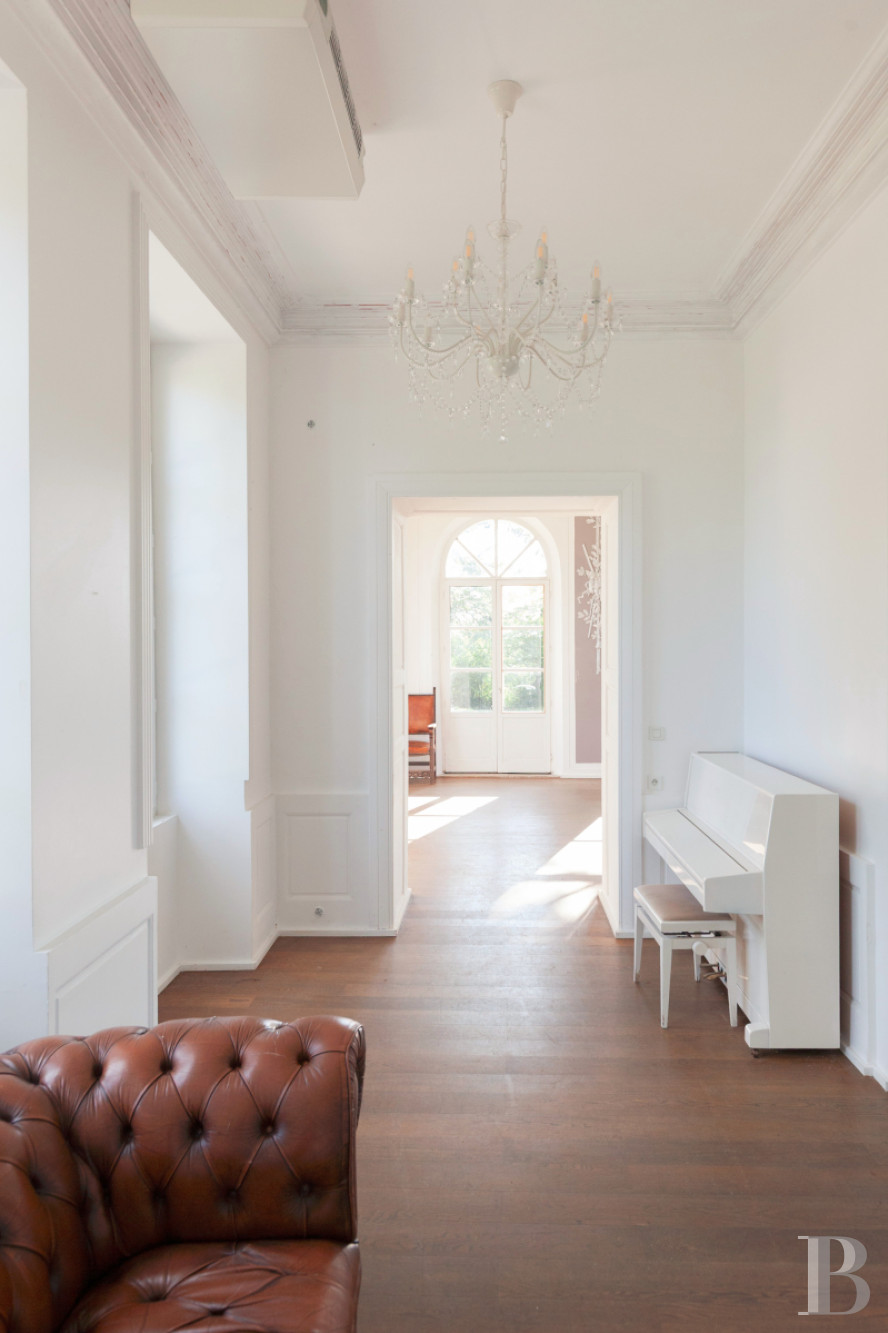
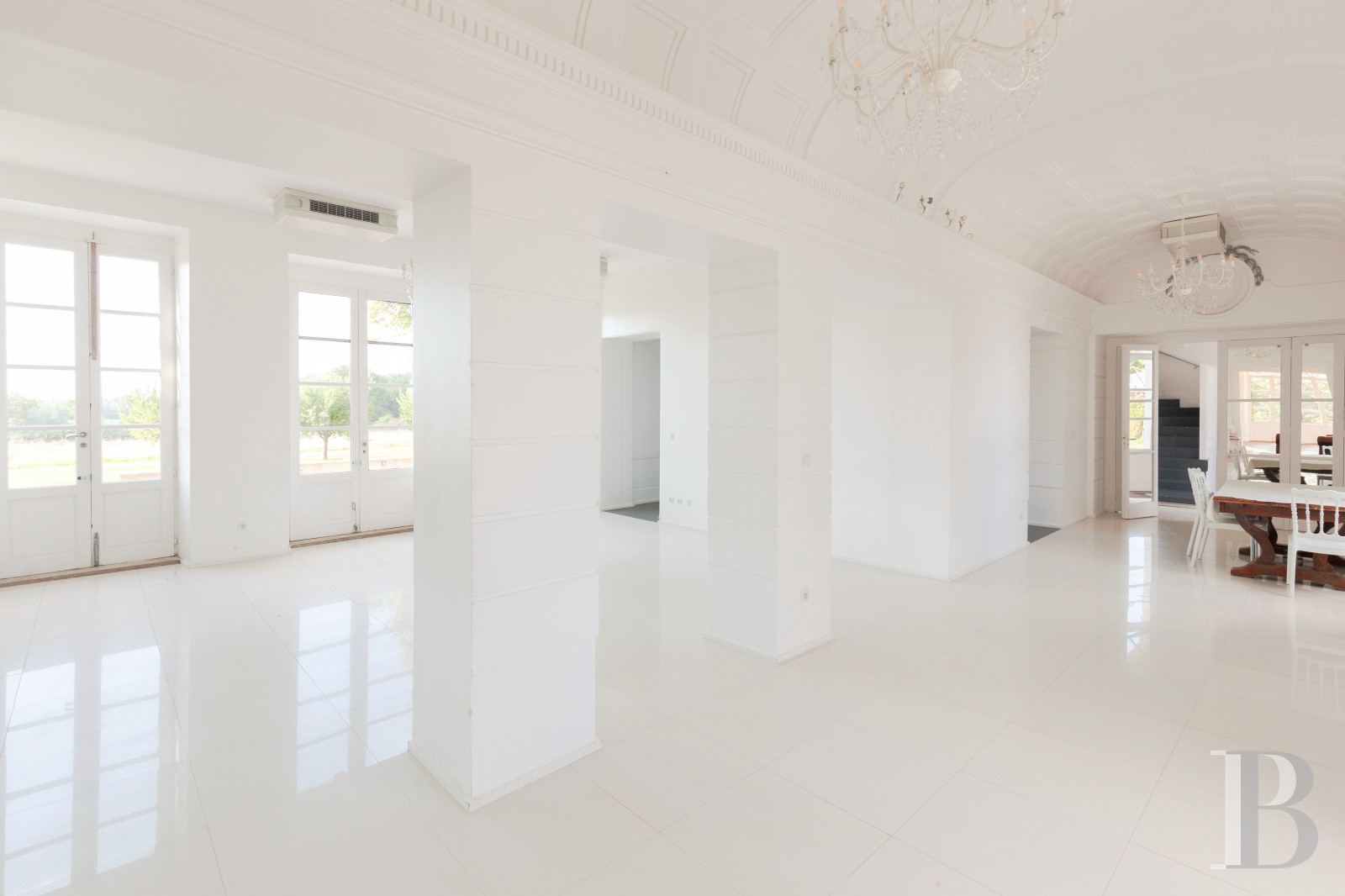
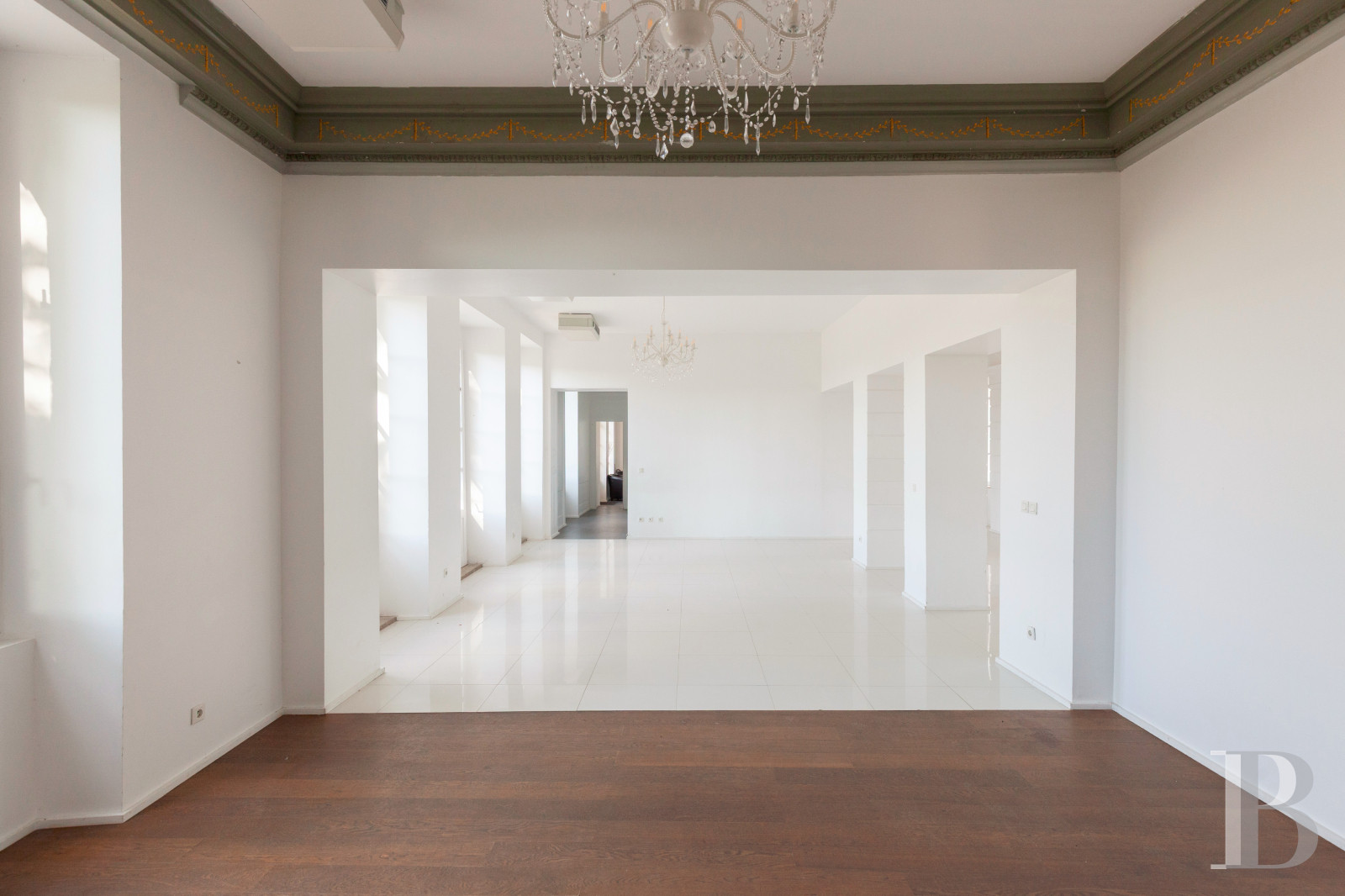
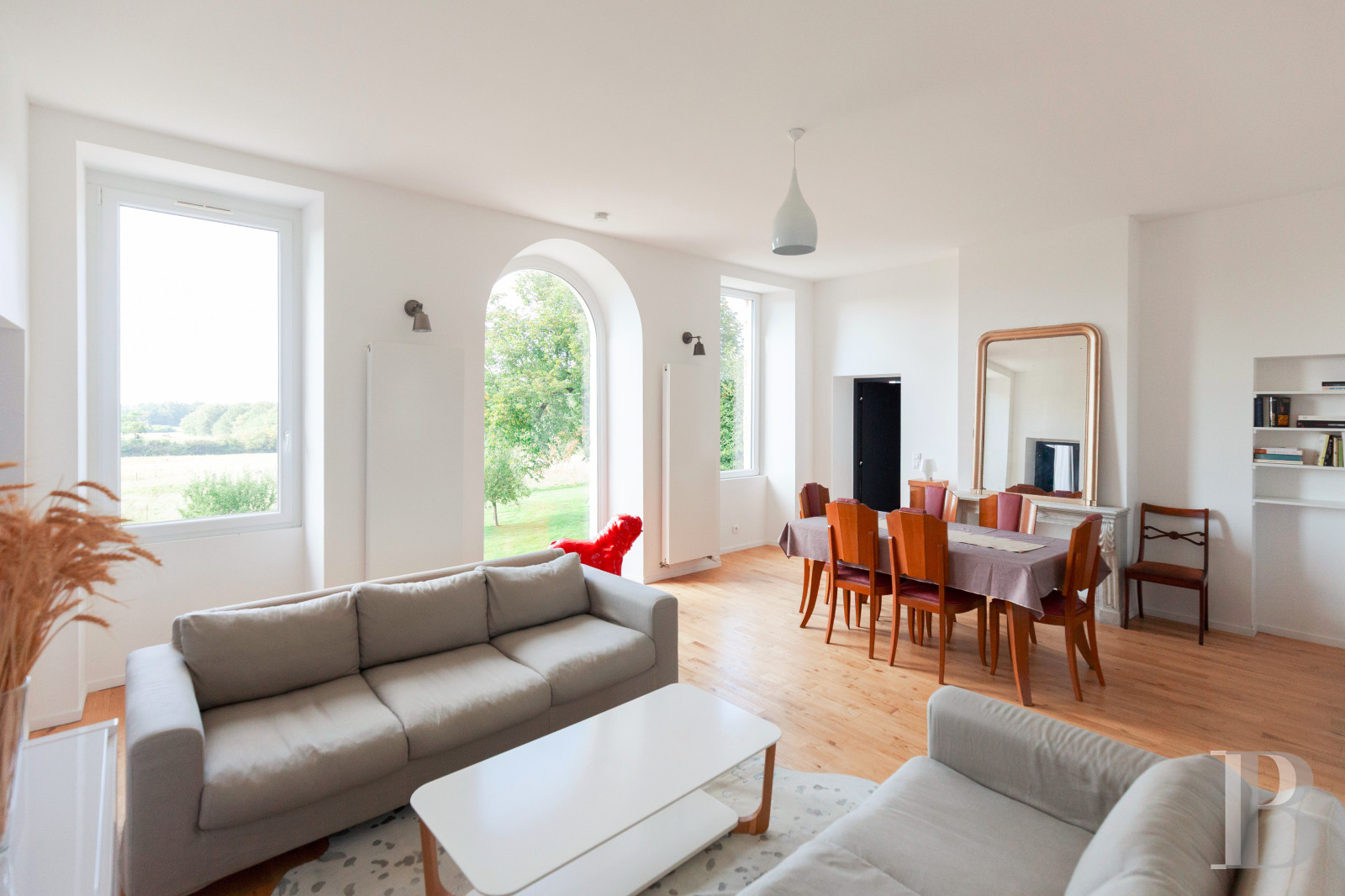
Beyond the entrance door, there is a vaulted gallery: a modern entrance hallway, elegantly understated in style. White dominates here, from the stone floor to the coffered ceiling. Pillars with rectangular bases demarcate a space made up of two rooms with wood strip flooring. The west side leads out to a terrace, where you can admire a view of an age-old oak tree that is impressive in size. On the left, a spacious hallway connects to a reading room and a reception room, at the south end of this level. This reception room has many stucco decorative features and French windows with fanlights. The inner wall features a red marble Empire style fireplace. In the right-hand section of the chateau, there is another entrance hall, which is smaller. It houses a staircase. A room adjoins the latter hallway. It connects to two lavatories and to two fitted kitchens with floors of stone slabs. One of these kitchens is a professional kitchen. This hallway also connects to a boiler room. In the middle, there is a lounge and a dining room with a white stone floor. French windows lead out from it westwards.
The upstairs
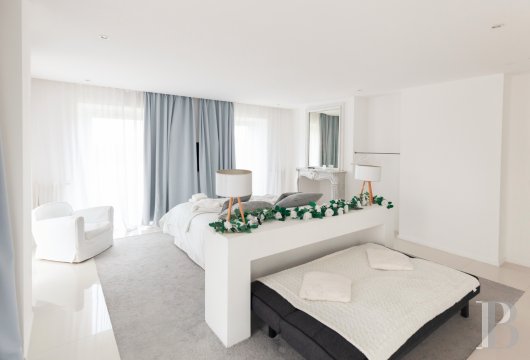
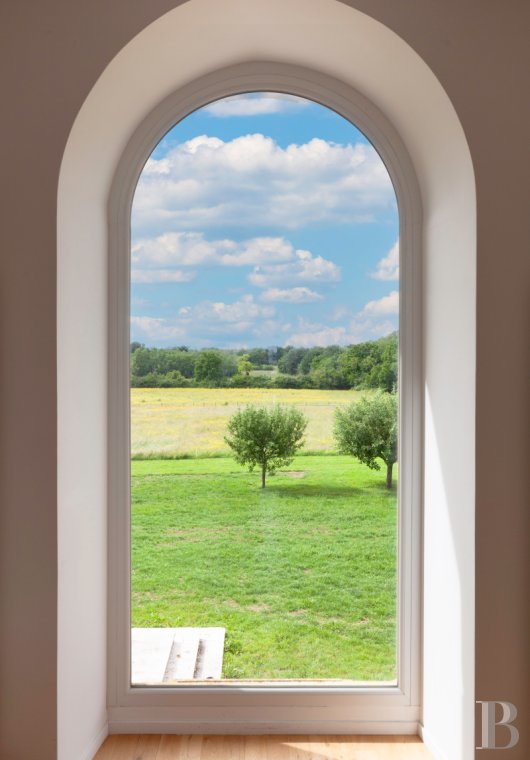
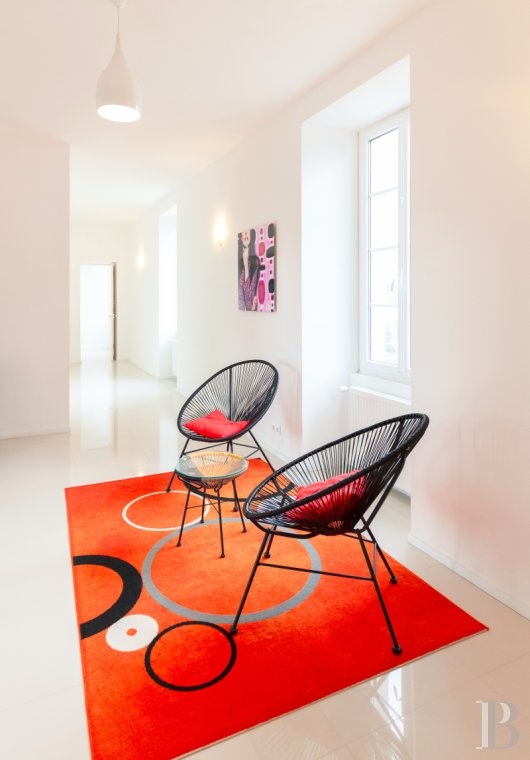
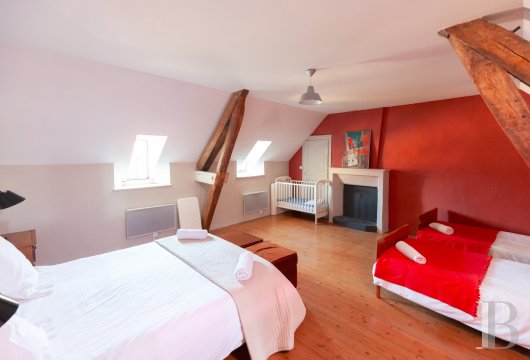
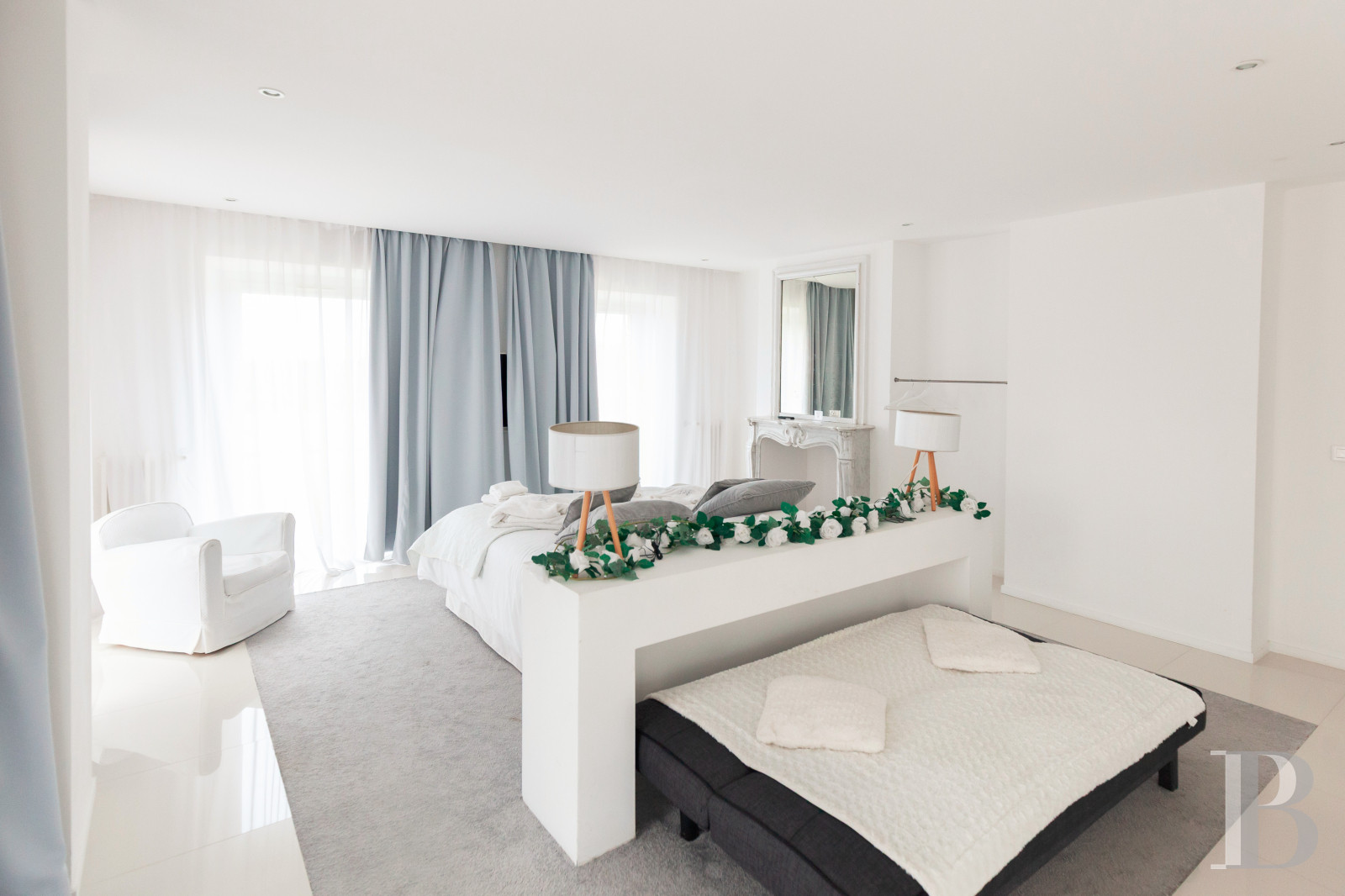
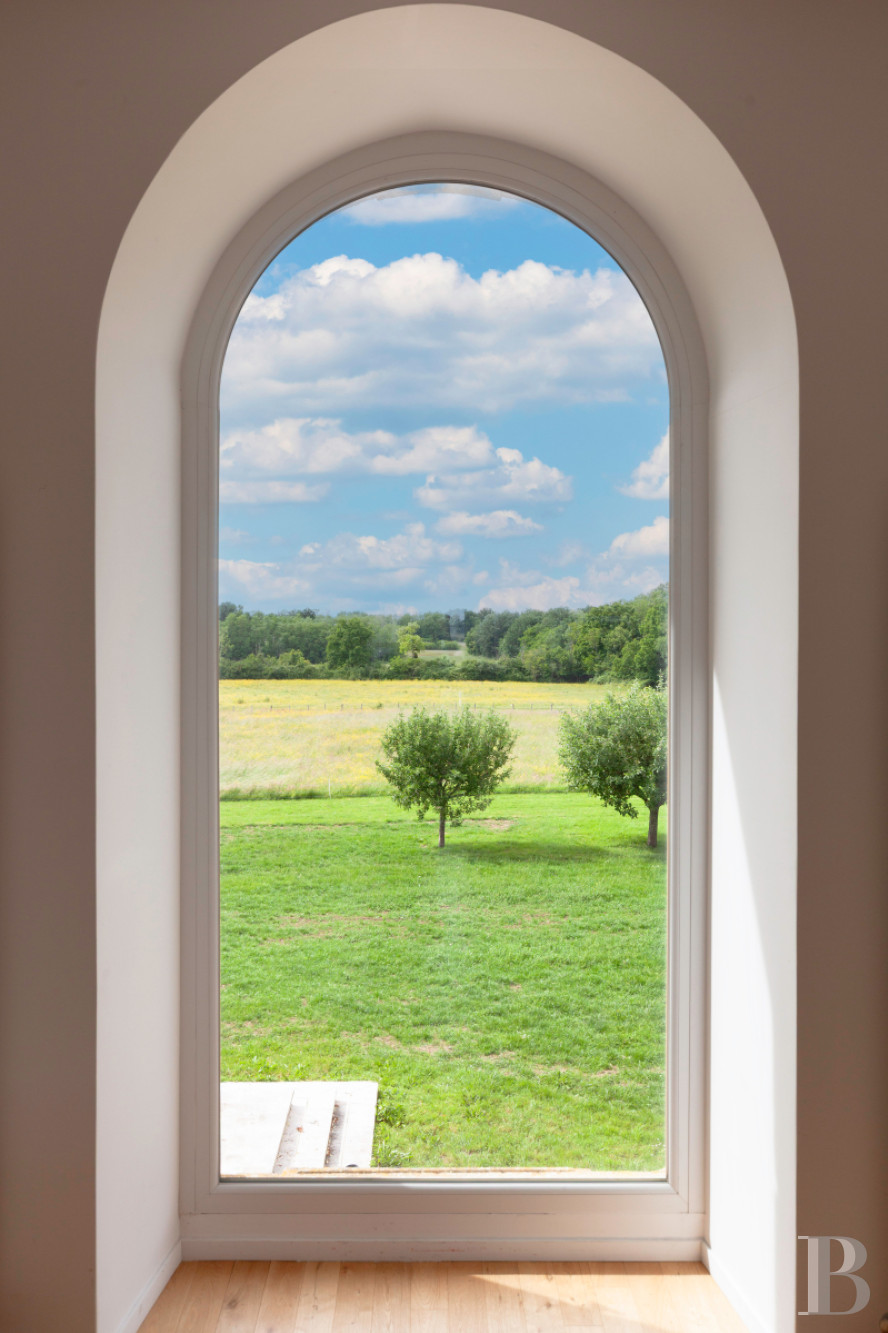
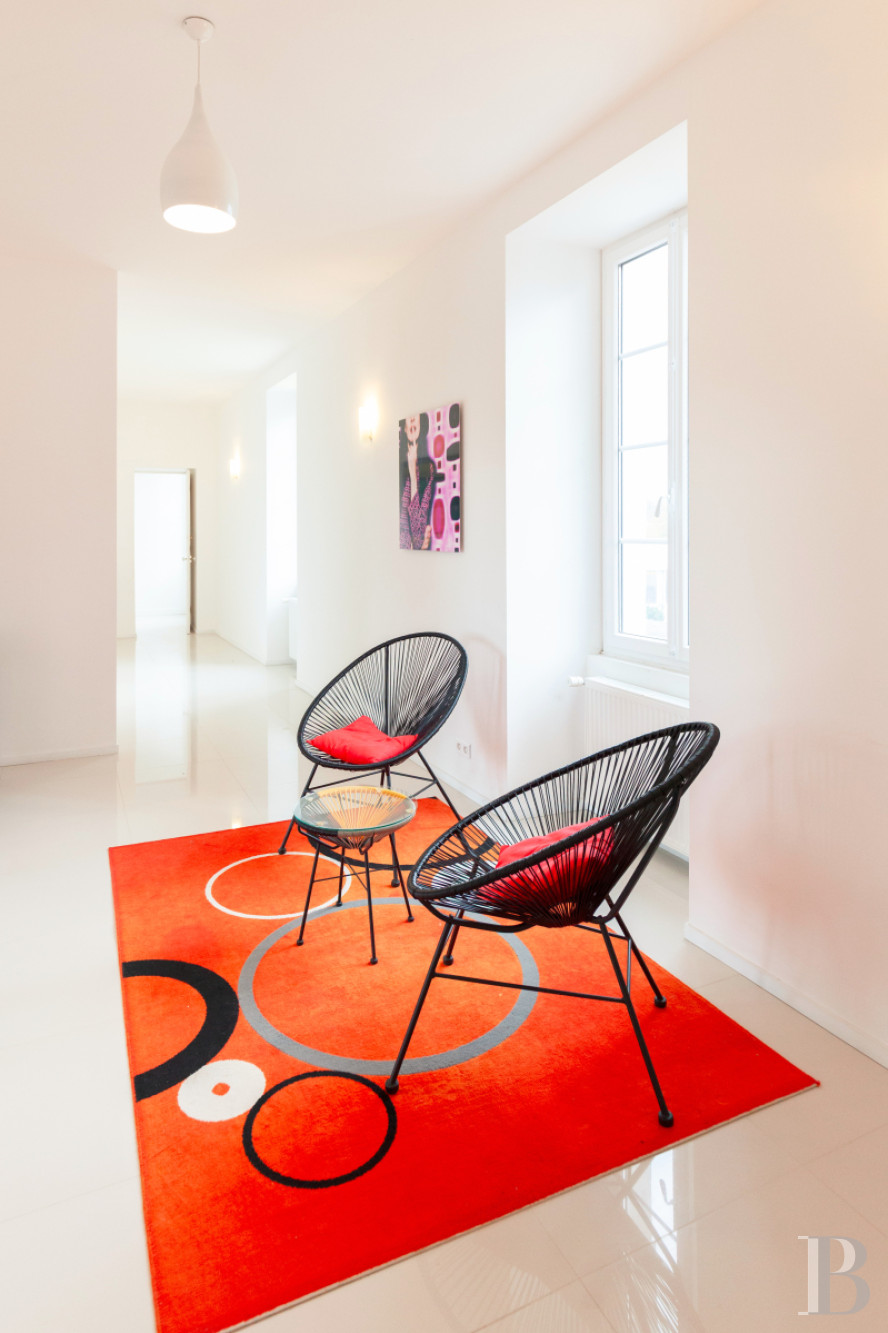
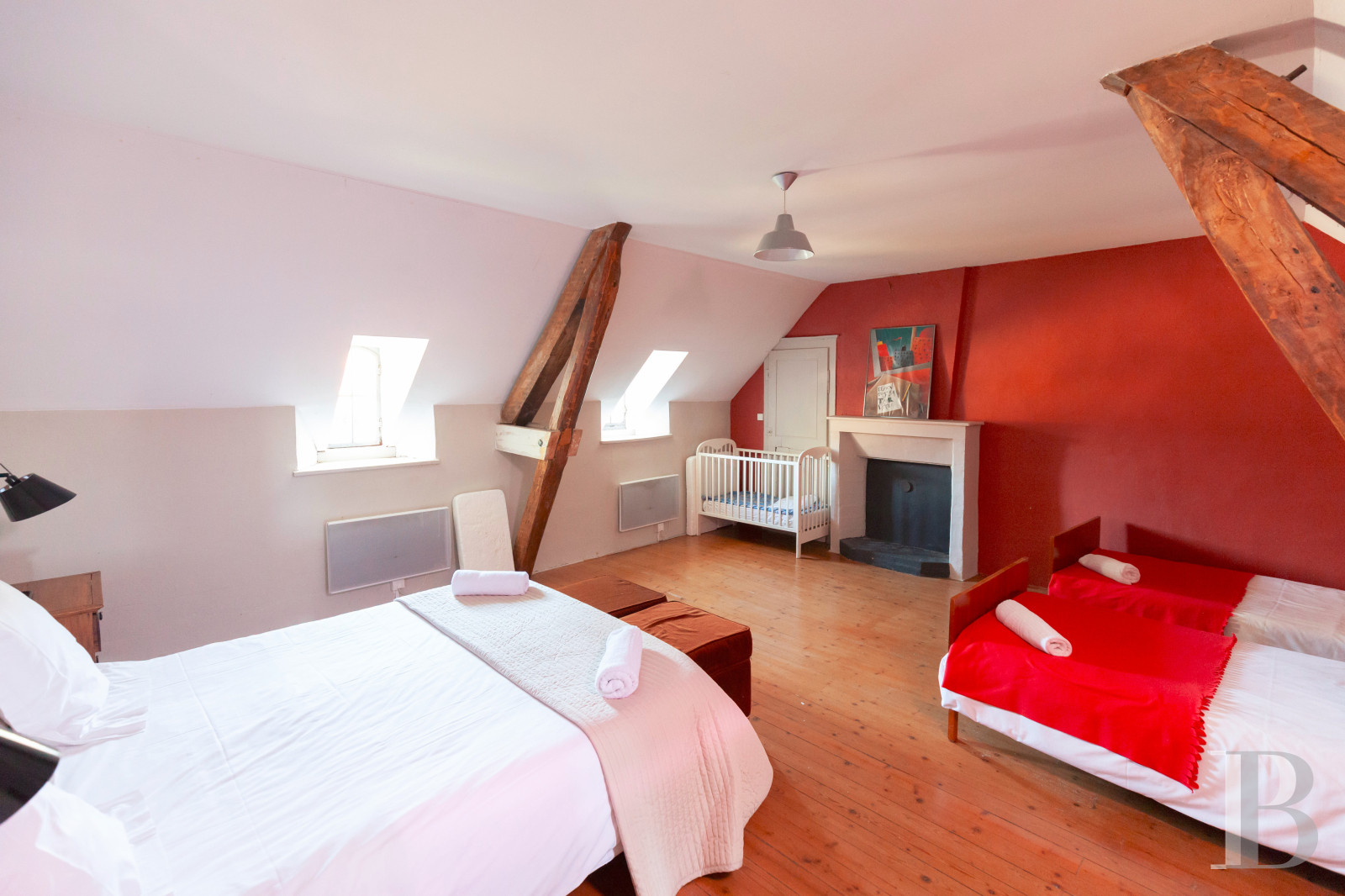
The painted stone staircase leads up to a landing that connects to a first bedroom, a door that takes you to the loft, and a separate bathroom with a lavatory. Beyond it, a large hallway connects to a section converted into a suite with three bedrooms, a spacious lounge, three lavatories and two shower rooms. The lounge is at the heart of this floor and connects to two of the suite’s bedrooms. The central window, in a niche, offers a scenic vista of the lush landscape that stretches into the distance. The last bedroom in the suite and on this floor is spacious and has a shower room. It is separate from the rest and is bathed in natural light.
The attic
The top floor is in a raw state with exposed roof beams. Yet it is high enough for you to stand up straight inside it. It represents huge potential as convertible space. On its east side, four dormers bring natural light inside, as do three roof windows on the west side. You reach this top space via a staircase from the first floor. Partition walls divide it into three sections with floors areas of around 20m² in the end spaces and around 50m² in the middle space.
The dovecote
The square dovecote offers a 63m² floor area. It is crowned with a pyramidal roof of Burgundy tiles. It has been completely renovated. On the ground floor, two tall windows set in brick surrounds have been made, bringing in all the natural light needed for the rooms. There is a lounge, a kitchen and a tiled shower room with a lavatory. A straight wooden staircase leads up to the first floor and connects, halfway up, to a mezzanine with a floor of broad wood strips. This mezzanine looks down discreetly at the lounge. The first floor offers two bedrooms, which also have wood strip flooring. They lie beside a shower room with a lavatory.
The elongated outhouse
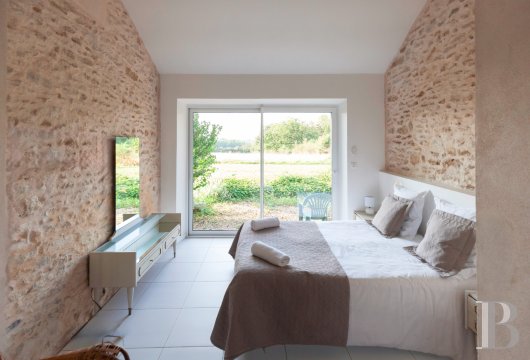
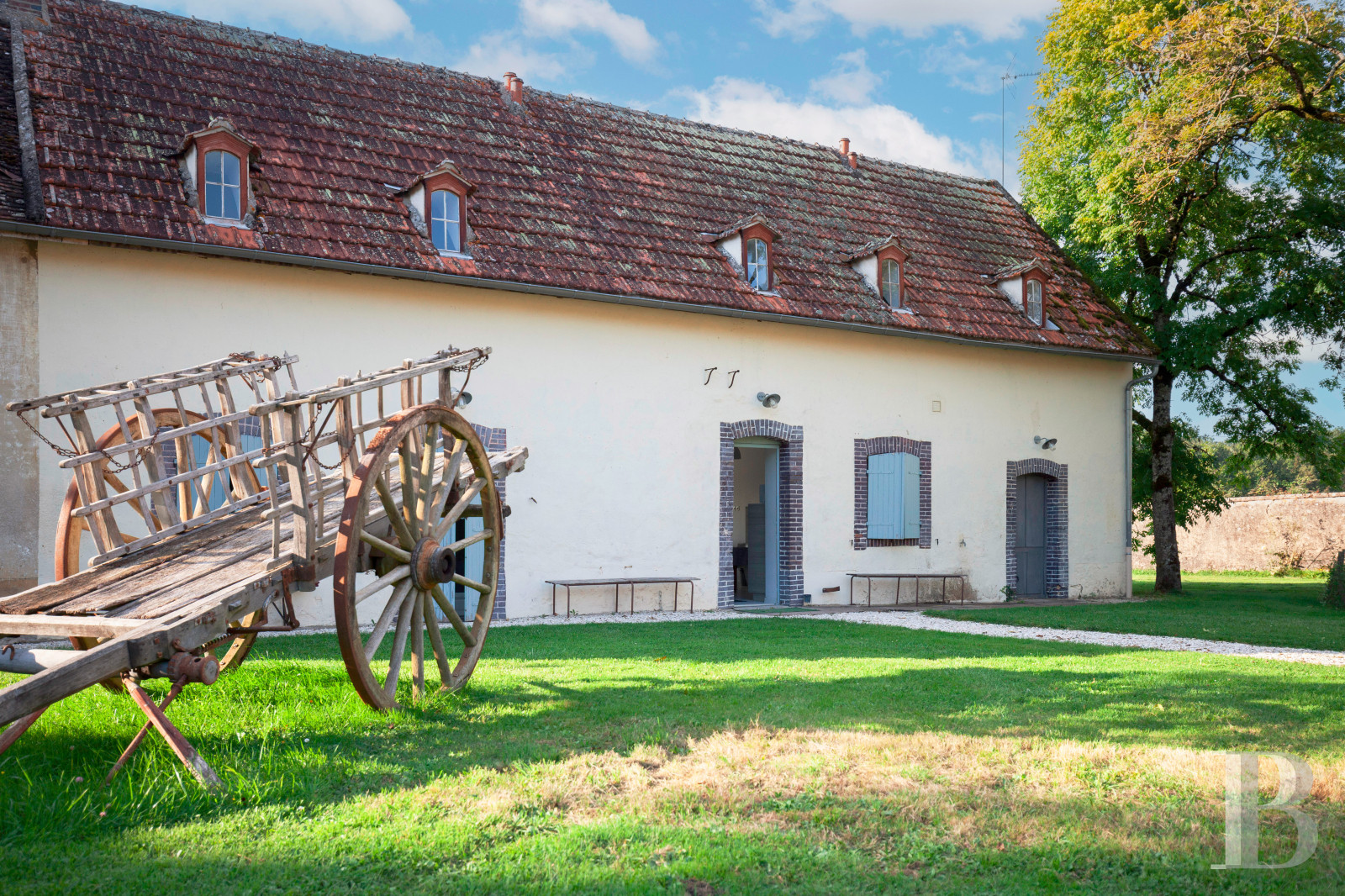
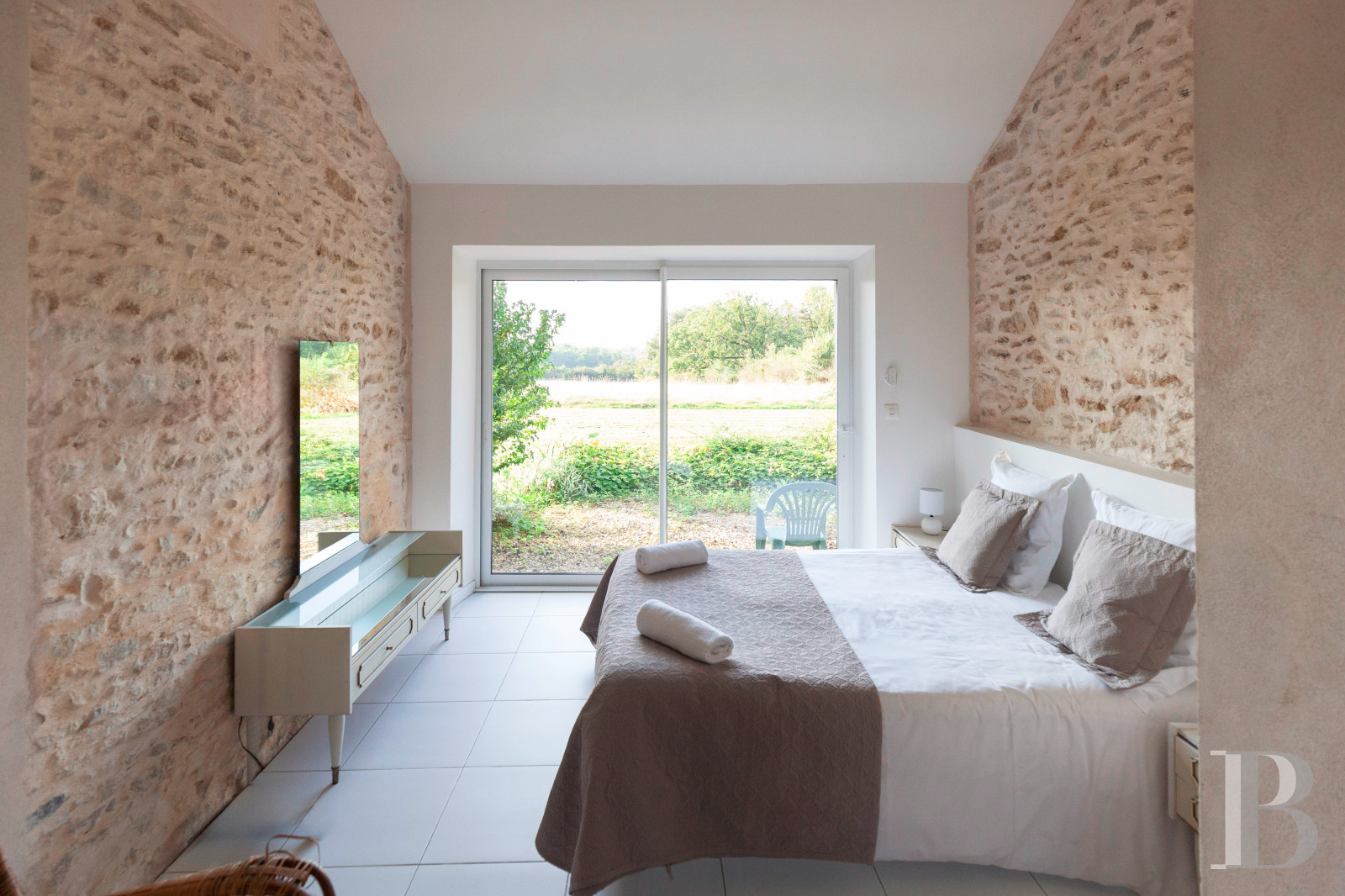
An elongated outhouse lies between the dovecote and the farmhouse. It has kept its two-slope roof of Burgundy tiles. Two hayloft doors have been partly filled in and turned into wall dormers. The building offers a 105m² floor area. On the ground floor, all the floors are terracotta-tiled, except in the entrance hall. There is a lounge with a kitchen, two bedrooms, a lavatory and a shower room with two showers. Two walls in the lounge have kept their exposed stonework with pointing, while the ceiling beams and joists are raw and exposed. The first floor has cathedral ceilings. Up here, there are four bedrooms, two lavatories and a shower room. A long landing connects to these rooms. Square and hexagonal terracotta tiles cover the floors.
The farmhouse
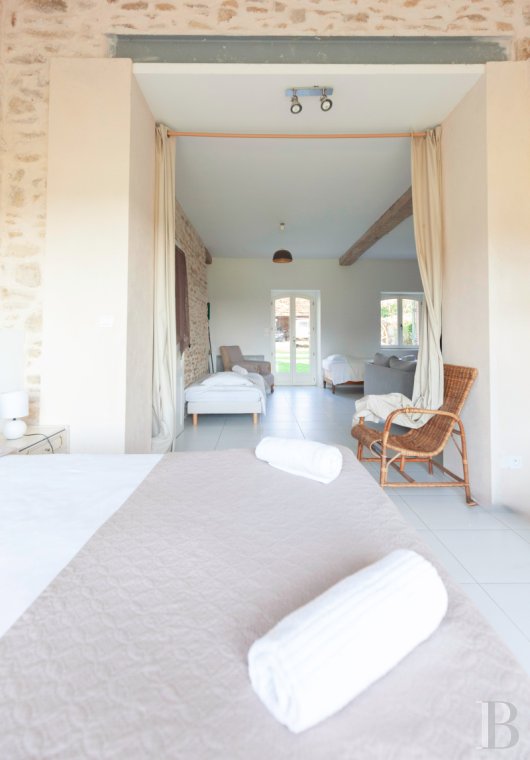
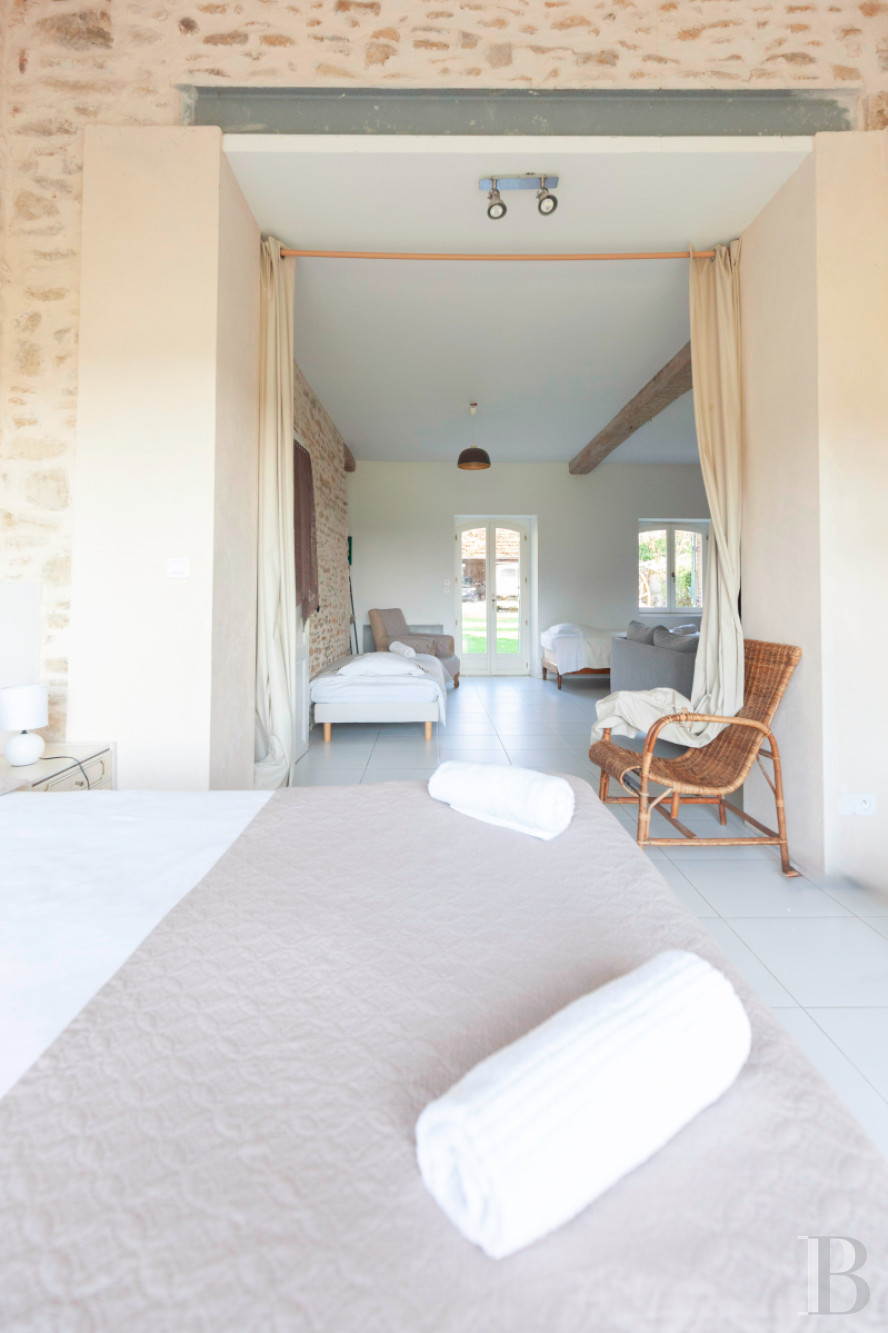
As you head northwards, the last of the three main outhouses is a building with two sections. It is crowned with a roof of flat interlocking tiles with five discreet gabled dormers. Its left-hand section adjoins the elongated building and houses a former bread oven. Its right-hand section, the biggest one, is taken up by a gîte. The whole building offers a 165m² floor area. Two spacious lounges with floors of white stone tiles share most of the ground floor. One of them has a fitted kitchen and the other one has kept a fireplace and walls of exposed stonework that give the interior a rustic character. Windows and glazed doors on the garden side bring an abundance of natural light inside all the spaces. A utility room, a shower room and a lavatory complete this ground floor. On the first floor, a landing connects to three bedrooms. There is also a lavatory and a bathroom up here. You can see roof beams on the sloping attic ceilings. Wood strip flooring extends across the rooms.
The annexes
The annexes stand opposite the outhouses. They have plain elevations with exposed stonework, timber lintels, surrounds of dressed stone or tiles, and two-slope roofs of flat tiles. There is a barn with a floor area of around 190m² and an adjoining annexe with a floor area of around 50m² that houses a cowshed. These two annexes are almost aligned with one another and are currently used for storage. Beyond the former cowshed, there is an extensive shelter with a roof of flat interlocking tiles. Three vehicles can be kept beneath this shelter.
The grounds
The grounds are lush and well maintained. They have different sections. Parkland extends around the chateau and is extended on the west side with meadows, trees and undergrowth. The whole estate covers more than seven hectares. Palm trees stand beside clusters of shrubs. Many coniferous and deciduous trees tower over the vast lawns. A garden court links together the outhouses and embellishes them with small lawns, flowers, shrubs and trees. Flowering plants add colour beside the different buildings. Climbing roses, a Virginia creeper, wisteria and other climbers cover their elevations here and there. And to the right of the chateau, there is a 12-metre-long gallery with brick-and-stone pillars covered with climbing roses. It adorns the intermediate area between the chateau and its grounds.
Our opinion
With its fine shape and remarkable ornamentation typical of the 18th century, this chateau is truly elegant. It survived a long period of neglect. Today, it offers fully converted outhouses and handy annexes with rustic charm that characterises Burgundy. Previously, wooden panelling had been torn off inside this noble edifice, as had fireplaces and parquet floors. Yet the current owners, very much attached to the chateau, brought back its past splendour masterfully with modern touches. The business in this chateau and on its lush grounds is highly lucrative. In short, everything here is ready for you to write the next chapter in its story and to carry on hosting travellers keen to discover the wealth of this renowned winegrowing region of France.
Reference 873115
| Main building floor area | 435 m² |
| Outbuildings floor area | 330 m² |
| Land registry surface area | 7 ha 9 a 51 ca |
| Total floor area | 765 m² |
French Energy Performance Diagnosis
Information on the risks to which this property is exposed is available on the website: www.georisques.gouv.fr
Share


NB: The above information is not only the result of our visit to the property; it is also based on information provided by the current owner. It is by no means comprehensive or strictly accurate especially where surface areas and construction dates are concerned. We cannot, therefore, be held liable for any misrepresentation.